
Writing is often a solitary activity. Writers spend their days living, and talking with imaginary people, inside our own heads. Existing in that wind tunnel and never coming out of it is not the healthiest way to move through the world (or around the outskirts of it). But, it can be difficult for a swath of people notorious for introversion to brave conferences, networking events, or new writers’ groups.
A lot of folks don’t even know where to meet other writers. But, like anyone else, writers need to connect with friends and colleagues. We need people who can relate to the experience of navigating complicated inner worlds and an even more complicated industry.
We need people to help us celebrate our writing successes and offer condolences for when we hit craters. We need networks that keep us grounded without pulling us down. Community, or as my guest Jessie Kwak puts it, constellations.
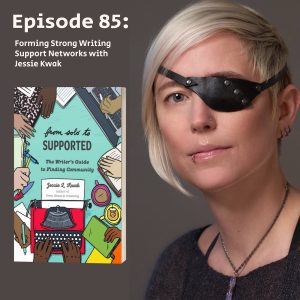
Jessie joins the podcast for a second time, this time to talk about her latest book, From Solo to Supported.
In this episode, we discuss many of the subjects covered in From Solo to Supported; everything from how to meet other writers, conversation starters for conferences, and how to navigate giving and receiving feedback.
Guest Bio: Jessie Kwak
Jessie Kwak is an author, storyteller, and business book ghostwriter living in Portland, Oregon. When she’s not writing, she can be found sewing, mountain biking, and exploring the Pacific Northwest (and beyond). She is the author of thriller novels, two series of space scoundrel sci-fi crime novels, and a handful of productivity books. I first talked with Jessie in Episode 59 about her book From Chaos to Creativity, and also posted about her book from the same series, From Big Idea to Book.
Interview Transcript
Can’t listen right now? Read my interview with Jessie below!
Emily Einolander 00:00
So I wanted to kind of start with a just warm up question for you as a writer, do you like listening to anything while you write?
Jessie Kwak 00:09
No, I can’t. Well, okay, I guess I will say, No, I can’t listen to music, anything with words or even like too much of a melody, is just so distracting to me. So I actually when I need white noise to kind of block out other things, like, for example, my husband right now is playing video games downstairs, so I have been listening to thunderstorms.
Emily Einolander 00:34
Oh my gosh. I love that. Yeah, like a
Jessie Kwak 00:37
thunderstorm YouTube video that is eight hours long, that is just always in an open town for me to hit play
Emily Einolander 00:45
that sounds like something I would love to try. I mean, I have the rain outside periodically, and apparently we’re going to have a pretty wet winter, so that that ought to do it, but at the same time, like That sounds lovely. Wonder if whale sounds would also be nice.
Jessie Kwak 01:00
It might I think the nice thing about the thunderstorm is that it’s so consistent. Like, every once in a while there’s a little of, like thunder, but mostly it’s just kind of this heavy rain, and so it’s a very consistent background texture. Whereas I wonder if whale sounds might be a little too like, Oh, there’s another one. I wonder what they’re thinking. I wonder what they’re talking about.
Emily Einolander 01:22
What are they trying to say to me? All right, so you’ve been on the show before when we talked about from chaos to creativity, and then you’ve done a couple of books in the interim in that series. I mean, I know you’ve done a lot of other books in the interim, but we had from big idea to book, and from dream to reality, and then the one we’re going to talk about today, which is from solo to supported. And there’s a workbook in there too, right?
Jessie Kwak 01:50
Yeah, there was a workbook related to, from chaos to creativity, yeah, okay,
Emily Einolander 01:56
that’s, that’s quite a very like, helpful toolkit of a series. Is there more on the horizon, or is would you say that you’ve pretty well like encapsulated the experience?
Jessie Kwak 02:10
I definitely there’s, there’s definitely more to say about kind of I guess, I guess, just to give a little bit more context, they’re all related to basically running a business as a writer and as a creative person. From cast of creativity is very much about like for any sort of creative, brained person who wants to get things done, and then the rest are much more writerly focused. And that’s that’s something that I just I love talking about, because I’ve been a freelance writer for 12 years now, and author of fiction books and nonfiction books at the same time, and just the the skill set it takes to run a writing business is very different than the skill set it takes to write a book. And so I’m always very interested in talking about that, that other kind of, more businessy skill set. So there’s, I mean, there’s plenty more things that we could talk about there, but I don’t have anything currently in the works.
Emily Einolander 03:10
Okay, well, let’s put a pin in, just like the overall writing business part of things, because I’ve, you know, wheels are turning, and I have selfish questions as well, because I’m trying to do the same thing. I mean, am, but it always feels like trying a little bit right, like your system is always changing. You’re always trying to figure out how to, like, really get into the groove of a new way of operating. I know that your experiment always experimenting with different, like technologies and stuff like that. So, yeah, I can see how that would be very expansive. But this book in particular is about something that I know is hard for a lot of writers to do, and that’s finding community and working in community. Because, you know, the life of a writer is often considered very solo, solo title of the book, but it’s, it’s hard to continue with any project when you don’t have someone, at least to talk about it with. So I think that this is a really like valuable tool. So when you refer to forming a writing community, you use the analogy of a constellation, which I love. Can you expand on what that means? And, you know, especially when it comes to different type of writer relationships,
Jessie Kwak 04:28
yeah, so I feel like there’s, there’s the stereotype of a writer who just, like is in their writing cave. You know, we think of like going on this retreat for months at a time. The Shining might be a good example.
Emily Einolander 04:45
You clearly have a viewpoint on where that’s going, slowly going mad with your typewriter.
Jessie Kwak 04:55
But in my experience, like you said, it’s way more fun. Way more supportive, if you at least have somebody to talk with your work about, let alone be able to share work with and get critique and feedback, or be able to share your joys with and say, Hey, I just sold a story, or I got a publishing contract, or whatever, or to show you share your disappointments. I mean, you know, there are just so many things that are really specific to the writers journey that a lot of people don’t understand. Like, you know, my husband, I’m like, he’s like, how was your day? And I’m like, my I was just really struggling. Like, I feel like my characters weren’t talking to me. And he’s like, so you had a bad day because your imaginary friends weren’t talking to you. Yeah, that’s so normal.
Emily Einolander 05:45
They are my imaginary colleagues. Thank you very much.
Jessie Kwak 05:48
Exactly, exactly. Um, so, yeah, so that’s kind of why I wanted to write this book, is just really help people find, like you said, those constellations. And the reason that I chose that metaphor is because I feel like there, when you start looking for community, you might be like, Okay, here’s this local writers conference, and you go and you’re like, Ah, I don’t fit here. Or here’s this critique group, and you show up and you’re like, this thing, it wasn’t quite for me. Maybe they’re all writing something different. And I think that can be very discouraging for people, especially if they have thought that maybe whatever group that they were about to join is like the epitome of the writer group in their area or their genre or whatever. And so it can feel very alienating if you don’t connect right away in a with a group. And so I really wanted to encourage people about, you know, don’t think about finding community as in plugging into an existing group. Although you can really find, you can find a lot of great friends in those groups. Think about it like you are the center of your own little writer constellation. And how can these different groups and different friends and different, you know, relationships that you build. How can those all relate to you as as kind of the core center of it? And I think this idea kind of came about because I have a lot of writer friends, especially here in Portland, and I am at the center of, you know, kind of the indie writer, a little genre writer. I’m leaning more into kind of thrillers as opposed to just science fiction now, and so I have a very unique constellation where, you know, a friend of mine who is traditionally published, who also writes those exact same genres, has a very has a different constellation, because he has gone and looked at, you know, plugged into other writers conferences that I haven’t because I’m going the indie route, so that, yeah, that just kind of inspired me to be like, All right, when it’s not about find the one group, it’s about find how you fit amid all of these
Emily Einolander 07:57
different groups. Do you have a constellation? Because I know you do non fiction, is there a separate one for that? Or would you say that there’s some overlap?
Jessie Kwak 08:05
I think there’s definitely some overlap. Um, I am constantly surprised at how many fiction authors have a non fiction book in them and vice versa. You know, there’s plenty of people who’ve like, they’ve written a bunch of business books. They’re like, I’ve always wanted to write that romance, yeah, and so I think there’s more overlap than than not, but I do definitely have kind of a distinct nonfiction, more businessy. And I also I ghost write business books for thought leaders and coaches and people like that, so they kind of fit more into that constellation of people who are not necessarily writing a book for fun or for to sell the book and make money off the book, but people who are creating a business and a book is part of that business model.
Emily Einolander 08:54
What do you think is the main barrier that separates writers from finding community?
Jessie Kwak 09:00
I think there’s a couple things. The main one is probably just not knowing where to look, especially when you’re a new writer, you may not know what, even how to Google like, what are writing conferences, my in my area, or even what like, what exists out there? You know, you might not realize that there are critique groups where people share their work, and that many of them are publicly listed and you can find them. You might not realize, like, I’m still finding conferences. There’s, like, a Southwest writers, Southwest Washington Writers Association Conference that couple of my friends went to, and they’re like, popping up on Instagram. Was like, wait, what? What conference is this? Like? I live right next to Southwest Washington. Why didn’t I know that there was a conference here? So I think that’s kind of the biggest thing, is just not knowing where to look. But then there’s also kind of the introversion, shyness part, which we like. To hang out with our imaginary friends all day because it is safe and comfortable and we don’t have to talk to other people. And that is definitely a barrier.
Emily Einolander 10:08
Yeah, for sure. Where are those listed for those who don’t know the critique groups and the conferences and things like that? Where would someone go to look for those there?
Jessie Kwak 10:20
I mean, so I tried to, like, have a comprehensive list in the book of, like, here’s places to go, and it, it was just so difficult, and it changes so quickly. Like, I mean, I even had a section in there about, like, finding community with, you know, in November, with NaNoWriMo, and we took that out at the last minute, because there’s right, NaNoWriMo no longer exists, exactly, you know, it was like, page proofs. And I was like, Oh, guys, we have to delete that section. And so what I ended up doing in the book was basically saying, like, here are some, some ways of googling that, you know, I didn’t just say, hey, Google it, but yeah, here’s some things to look for. Here’s some, some of the keywords that you might plug in to try to find your your people, but meetup.org is a pretty solid one. That’s where, especially in Portland, I’ve found a lot of different write ins where people are just getting together. They’re not necessarily sharing work. They’re just setting timers and having a cup of coffee or a beer or whatever, and writing together in a space. So that is a really, if you’re trying to meet writer friends, like a write in can be a really, really, really great place to do that, because it’s there’s no pressure. You don’t have to, like, get up and talk. You can just show up with your headphones and write with other people. And, you know, on the breaks, have more communication, but
Emily Einolander 11:43
yeah, and that’s a great place to start, too, because I know that some people have trouble completing projects unless there’s someone not necessarily holding you accountable, but at least witnessing You and witnessing the fact that you’re working on your stuff. And it’s nice to have people to care
Jessie Kwak 11:59
about it too. Yeah, it’s, I mean, if somebody else can see your screen and you’re on a 45 minute writing sprint, you’re probably not going to jump over to social media. You’re like the person next to me is working hard. I guess I will continue working. It’s very helpful.
Emily Einolander 12:18
So imposter syndrome, if we’re talking about barriers, big part of basically any field at all, or even just social situations. So if someone doesn’t feel like they’re a quote, unquote, real writer, or they don’t feel like they’re worthy of being in the community with other writers, how would you recommend that they navigate that?
Jessie Kwak 12:41
I would say, I mean, first off, I want to recognize that there are definitely communities of writers out there where, if you walk in the door and you haven’t published in a fancy literary journal, or you haven’t met some level of criteria, you are going to get snubbed, like there is that out there, which sucks, but it’s also such a small percentage, especially these days. So I want to encourage anybody like, if you’ve had that experience, like, yeah, I’ve had that experience
Emily Einolander 13:09
too awful, but feel invisible,
Jessie Kwak 13:14
yeah, yeah. But the majority of writer communities that I have found since then have been very, very open and welcoming. And I think maybe with kind of the rise of self publishing, there is less of this, like stigma against, Oh, you, you didn’t do it the right way, or you don’t have the right credential, or whatever. So I think there’s just a lot more openness to everybody. So I guess that’s the first thing I would say, is you’re probably not going to have that experience, especially more and more these days, and if you do have that experience, that’s why I’m saying, build your own constellation. Screw those guys. Go meet some new people.
Emily Einolander 13:56
Yeah, don’t try to make them like you. Yeah, exactly.
Jessie Kwak 14:00
But the other thing I would say is that, like, if you’re a writer, or if you’re writing, you’re a writer and people, there’s this whole spectrum of people who write just because they feel like writing, and they like telling stories, and they’re not really trying to get published, and they don’t really care to People who are building a professional career and thinking about writing in a very different way. And it’s like, like, my mom’s really into pickleball now, right? And she’s just out playing pickleball with her friends because it’s fun, and she’s surrounded by people who are just doing it because it’s fun. Like, none of them are trying to get to the Olympics, and nobody’s like, hey, just because you’re not trying to get to the Olympics, you know, therefore you’re not a real pickleball player, it’s like, did you pick up a pickleball paddle? I think it’s what you call them. Then, yeah, you’re a pickleball player. So I wish there was a little bit more about that with writing. Like, did you write? Great, you’re a writer. Come join us.
Emily Einolander 14:58
Yeah, in. The writers critique group I’m in, one of the people we were talking about. They were like, you know, that person who’s always working on their fan on outlining their fantasy novel, the person who’s outlining it all the time, working on their world building all the time, and they never seem to get around to it. That’s actually great. Like, they’re like, that’s if you are having a great time. We’re all gonna die someday. And if that’s the way that you find enjoyment, then, you know, just do it and don’t feel bad about it.
Jessie Kwak 15:29
Yeah, absolutely. I mean, I will add to that, if you’re hoping to get published, like you do, need to actually learn how to finish
Emily Einolander 15:36
projects, that’s that’s true, but if you’re not just
Jessie Kwak 15:39
there for the fun of it, like, do what’s fun and do the fun parts and enjoy that. And don’t let anyone like, pressure you into feeling like, oh, well, I should be moving on, or I should be this. Like, it depends on your goal, and if your goal is to hang out and have fun and tell a good story, then do it.
Emily Einolander 15:56
So if someone does find that, let’s say it’s a networking event or a conference when there’s multiple people, and it’s not necessarily like the write in thing. How would you recommend someone set themselves up for success instead of, you know, not actually meeting anybody because they’re too scared or something like that.
Jessie Kwak 16:20
Like, I know everyone kind of talks down on small talk, but like, it is how we build connections with people. You know, that little moment of like, hey, it was raining. Yeah, it was raining. This was my experience with the rain. This is my experience with the rain on the way here. Like, you’ve built a little spark of connection. And, you know, asking people where are you from, or how long have you been writing, or things like that, like all of those little small talk questions, build, build these little sparks of connection, and you can build off that. So in the book, I have a whole list of like potential questions that and like conversation starters for writers, and they’re everything from, like, you know, how long have you been writing? What have you been working on? What? What genre do you like to read? You know, what’s the most interesting thing that you’ve read recently? You know, because we’re all reading
Emily Einolander 17:11
stuff ideally,
Jessie Kwak 17:14
yeah, and so I like kind of coming prepared with a few of those set questions, and it doesn’t matter if you ask them awkwardly, like the point is getting a conversation started. And the other big thing to remember is that, especially if you’re at a writer event, probably everybody is awkward and shy and doesn’t know how to talk to other people. So if you can develop the skill and that little bit of courage to be the first person that says, hey, I’m Jesse. Do you mind if I sit here? What do you write? Is this your first time at this conference? Like you will be a hero to some people who just, like wanted to talk but didn’t know how to meet somebody. I mean, and I’ve heard that from many people who are especially when I was early on, and I was like, okay, just go talk. Just go talk. And, like, I was terrified, and somebody’s like, Oh, thank you for coming over and saying hi.
Emily Einolander 18:06
Like, I didn’t know what to do. Yeah, do you I mean, I imagine it’s different every time, depending on the circumstance, but do you kind of have a favorite go to question?
Jessie Kwak 18:18
I think so. If I’m at like, a an event. I always like to ask, like, Have you been to this event before? Especially if it’s like, my first time, then I can go, you know, oh, you’re you’ve been here a few times. All right, what can I expect? You know, you can get some knowledge that way. So that’s, I think, a favorite of mine. I really hate talking about what we’re working on. Like, I hate it when somebody asks me what I’m writing, because,
Emily Einolander 18:44
yeah, it’s like asking someone. It’s like asking someone what they do for work and then finding out they’re unemployed.
Jessie Kwak 18:50
Yeah, I don’t want to be like, Oh, I haven’t written in a week. Or, like, here, or ask somebody and then suddenly, like, four hours later, you’ve gotten a detailed version. Don’t do this big caveat if something, if you’re talking about what you’re working on, please do not outline your entire novel to
Emily Einolander 19:07
somebody Yeah, you mentioned having the actual, like, elevator pitch for your work in progress, even just you know, like limiting it to a certain span of time and being ready to talk about it. And as someone who you know needs scripts in general. Like, that’s a brilliant idea.
Jessie Kwak 19:24
Oh, yeah, yeah. I mean, I can, like, at this point, I’ve, I have trained myself into some level of extroversion that Jesse from 10 years ago would not recognize. So, like, I can hold a conversation, no problem. But the instant you’re like, Oh, you write. What do you write? Just like, blank, blank, blank, blank. So I have a script.
Emily Einolander 19:45
I have a list of, like, my favorite books in my notes app, just because it’s like, I’ve never read a book in my life. If someone asked me what my
Jessie Kwak 19:51
favorite, that’s a good idea. I should do that. Yeah, because I’m always like, I don’t I don’t remember what I was reading last night. I.
Emily Einolander 20:00
Like, I haven’t actually read that many books. Meanwhile, yes, I have. There’s an element, you know, you can’t overdo this, obviously. And I think that’s why I’m asking the question, like, there is self promotion involved sometimes when you’re networking, and how would people go about that in a way that isn’t tacky.
Jessie Kwak 20:21
So I think it’s important to know, like, where, where you’re at, and what the purpose of the event is. If it is a making friends event, like you’re not, you’re not there to sell your book to readers, so like, talk to people about what you’re working on. Often people will be like, Oh, that sounds great. Do you have a link to your website or whatever, in which case it’s nice to have like a QR code on your phone in your favorite photos or whatever, or a business card or something you can hand out. But most kind of writery events, they’re really there to make connections with the other people. So if somebody asks, give them a link to your book. Otherwise, just, you know, don’t make it easy. Take Daisy, take a seat on any sort of self promotion.
Emily Einolander 21:07
For sure, one thing I felt, in terms of like networking, one thing I felt kind of called out on, and in a good way, is like, if you go with friends, don’t just talk to your friends the whole time, because that’s like, one of my hugest like inclinations is just like, I know that person, I’m going to go talk to go talk to them the entire event, and then, you know, you’re not meeting new people.
Jessie Kwak 21:26
So, yeah, that is, I would say, one of the biggest kind of misses I see with people who are, you know, oh, I went there and I didn’t really meet anybody. It’s like, Well, did you? Did you spend the entire time with Sarah?
Emily Einolander 21:39
Yeah, exactly. It’s like I had a great time, but, you know, I also had them to my house last week, yeah, yeah, yeah.
Jessie Kwak 21:47
So I think there, there needs to be a balance, because, you know, it’s, it’s safe to go talk to the person you know. And there are definitely times like I went to a conference like author nation, which is, like, the big author, indie author conference, and it happens every year in Las Vegas, and there are people I only see at that conference. So yeah, I am going to spend a lot of time having dinner and coffees and talking to my friends. But I also was like, All right, I’ve been talking to Blaine too long. I need to go talk to somebody. I need that person standing over there. Looks interesting. I need to go meet a new person. So I think the way to combat that is to to know that going in that, okay, I’m going to meet X new people today and talk to your friends about it and say, Okay, we’re going to this event together, but one of my big goals is to meet new people, so let’s split up and then meet back together in 20 minutes, and hopefully one of us can bring a friend back to join our little group, or, you know, something like that, make it a little bit of a game and get the other person involved. That actually sounds really fun, yeah. Got it like doubling your networking,
Emily Einolander 22:55
yeah, and then it’s more of a community experience, rather than just like the one to one, yeah, yeah, exactly. So if you are meeting all of these people at an event successfully, how do you make sure that you stay in touch afterward? If you want to, of course,
Jessie Kwak 23:11
yeah, that is, I’m like, not great at that, necessarily. I would say, like, have maybe the social media platform that you normally use. So for me, it’s Instagram, because that’s just where I like to be. So I’ll be like, you know, oh, are you on Instagram? Great. I’ll add you here, and therefore, I’m at least kind of seeing you. If there was something specific that I wanted to follow up with them on I will definitely. I’ll make myself a little note, like email that person, you know that book recommendation that I couldn’t remember because I haven’t
Emily Einolander 23:43
ever read a book in my life.
Jessie Kwak 23:46
When I wake up at 3am I’ll email you what I remembered. So I always have a little either a notepad or a Notes app on my phone where I just kind of keep a running list of like, oh, I needed to follow up with this person about that. And then so in like a professional networking context, I actually do have, like a networking tracker spreadsheet where I add people in, and can kind of go back and be like, who was that person I met, who ran that nonprofit for consumer packaged goods business owners?
Emily Einolander 24:18
You know, right? Yeah, that’s the that’s the thought leader sort of element of things. Yes, that’s the thought leader constellation.
Jessie Kwak 24:25
Yeah, but I don’t think you need to go that hardcore. Like, if somebody seemed cool, definitely keep in touch. If they’re local, like, grab coffee or do a virtual coffee. I think that’s one of the biggest missed opportunities that I see people who maybe go to a conference and are like, oh, man, that person seems cool and I’ll never see them again. It’s like, we have zoom, yeah, yeah, set up a coffee date.
Emily Einolander 24:53
And honestly, I like virtual coffees. Maybe it’s because, like, I’m comfortable podcasting, but like, I you know, if. Someone asked me on LinkedIn, and we’re in the same field, and they just want to chat like, I love it. It’s nice to meet new people sometimes, or, you know, to go back and catch up with old people. I mean, I’m still comfortable with it after the pandemic. I don’t know if other people continue to be, but I think it’s probably easier for a lot of
Jessie Kwak 25:16
us at this point. And it’s, I mean, it’s an easier ask, you know, if it’s like, Hey, do you want to do a 30 minute coffee date on zoom at 2pm on Thursday or whatever? Like, that’s 30 minutes of your time, as opposed to, all right, I have to drive to the place, or bike to the place and find the parking and, like, have the coffee date, which is probably going to be 90 minutes because it’s in person instead of, you know, and so it’s way easier to schedule. Like, if somebody pings me to like, Hey, can we do a 30 minute zoom call? We can schedule that all day long. But if you’re like, Can we meet for coffee this week? I’m like,
Emily Einolander 25:49
that’s like, I don’t know, gonna be my whole afternoon? Yeah, exactly. So I think people
Jessie Kwak 25:55
don’t realize how small an ask that really is, yeah, yeah. And probably the other person wants to keep in touch too, and if they don’t trust that, they will politely say No, and that’s okay, I think that’s the other part. Is we are afraid to ask for things because we don’t want to be a bother. And this is something I have had to learn, like I have to trust in the other person, and I have to trust that if they don’t want to have coffee with me, they will tell me. They will tell me no, because I can’t, I can’t make that decision for them. And if they don’t have good boundaries, like they need to figure that out for themselves, and that’s actually not my fault.
Emily Einolander 26:32
No, yeah, exactly. And also, I mean, I think that it’s important that we trust ourselves to say no if we need to Yes. And you do get into some of the trickier, like social, you know, beyond meeting someone, just having a relationship, friendship, professional relationship with people in your writing constellation, and you deal with some of that stuff that I think people don’t really talk about that much. And one of my favorites was how to kind of negotiate giving and getting feedback from people who are also, you know, you consider a friend, because if someone doesn’t like your stuff, or if you don’t like someone else’s stuff, that can be really awkward.
Jessie Kwak 27:16
Yes, yeah, it really can be. I, I have a I just don’t read, like, beta read for people anymore, because it’s a lot of energy. And if it’s not good, then it’s so hard,
Emily Einolander 27:31
this weird resentment that comes up, and then you like, kind of hate yourself for it.
Jessie Kwak 27:35
Yeah, exactly. I’m like, Why did I say yes? So, you know, I have a in terms of, you know, trusting myself and my boundaries. I just have a role where, if somebody’s like, if I could just send you that, I’m like, No, I don’t do that. I don’t consult that way. I don’t beta read that way. But I think so if, if you are considering doing beta reading with people, or like, you know, sharing your work, do a trial run, like, do a short story. Start with a short story. Don’t say, hey, let’s trade novels. And then you get the first chapter of their novel, and you’re like, oh, no, what am I in for? Do a trial run with short stories? Because a and it’s not just that their writing might not be great. It’s like, it might not be your genre. Yeah, you know, if somebody gives me a romance to read, I just, I don’t read enough of them to know if you’re hitting the trips, right? Like, if you give me a cozy mystery, I’m gonna be like, I mean, this is pretty good, but, like, Where was the stabby bits? Like, yeah, you’re
Emily Einolander 28:33
like, why I know? And they’re
Jessie Kwak 28:35
like, well, that’s the point. Oh, okay. So I think it’s really important to know what you are good at giving feedback on and if you and to be able to bow out and be like, hey, that’s, I don’t know enough about that genre. Like I could tell you if it was a fun read, but I’m not going to be able to hit the certain
Emily Einolander 28:56
tropes or whatever. Yeah, yeah. You’re, you’re not the go to person for that one. Yeah. But regardless of whether you’re in the same genre or not, you might recommend sort of keeping your friendships and your like beta reading type stuff separate in general. Or is that just a rule you’ve created for yourself? It’s a rule
Jessie Kwak 29:13
I’ve created my for myself. I think, like, you’ve mentioned your critique group a couple times, and so I, I think, like, finding that group of people that you can work with on a regular basis is probably the most helpful thing you can do. Um, and that’s like, I don’t know, would you share a little bit about how you came across your critique group and how you guys have gotten involved, because that’s something that I have done in the past, but don’t have really any
Emily Einolander 29:40
there is a person who one of the one person is just a really good connector and like, good at telling people who might be able to get along together. We actually started hanging out, watching movies in genres we liked. And then someone was like, hey, you know, I’ve. Looking for a critique group, and then we kind of formed it that way. And I don’t know if that’s ideal, but we but it has been nice. And I think it was just we got lucky to find people who are gracious in that way. But I have been in critique groups in the past where it was just not cohesive so much. And I think that’s more likely if I go into a place sight unseen, with people I don’t know, but I know that that’s unavoidable. In some cases, it’s not so much a I’m going to hand them my entire book and have them beta read. For me, I think it’s more of a kind of mutual support. And then, you know, excerpts and short stories and stuff like that, which I feel is a little different than asking someone to read your entire book.
Jessie Kwak 30:45
Yeah, and like, in terms of asking somebody to read your entire book, I thought is some definitely something I have done, and have have occasionally done for other people, but when in those situations, this just kind of popped into my mind, and I wanted to share it like I gave a book to a friend who he read maybe about a third of it, and he was like, you know, I’m hitting a lawn on a lot of the same notes that you’re going to have to fix, that I assume are going to continue on and like. So here’s my feedback for the first third, I didn’t continue on. And I was not offended in the slightest. I was just like, Thanks for protecting your time. It certainly, you know, if you wanted to get to the end and you read the whole thing, awesome, but like, you read enough to give me some good feedback on these notes, I didn’t particularly need, like, I hadn’t asked him, like, I need to know how this ending lands. So I think, you know, just in terms of graciously giving and receiving feedback, like, it’s okay to bow out if you’re like, you know, this actually wasn’t for me. Here’s what I was able to talk about, you know, things like I could share. So there’s think about that, I guess.
Emily Einolander 31:58
Do you have any sort of best practices for being gracious about giving and receiving feedback.
Jessie Kwak 32:07
It’s so hard and like I’m a little skewed right now, because my husband has been my beta reader for the last few years, five, six years, and he’s has been terrible at giving me, like, feedback. Like, I mean, I It’s like, crying, you know, he’s like, All right, we’re gonna go cry about your novel this weekend. Like, and it’s been, I mean, the novels are so much better because of it. Like, we’ve, we have figured out how to, how to do this together, but so part of me is just like, I don’t know, just give me the brutal thing and I’ll because I’m used to it.
Emily Einolander 32:44
So sometimes, sometimes, if you have that kind of relationship, it can be brutal, but other times, you need to be more tactful.
Jessie Kwak 32:51
Yes, and I think the way to be more tactful that my husband could learn is to be like, this works for me or doesn’t work for me, as opposed to, like, you did this wrong? Yeah, exactly. He’ll literally sometimes write in the margin, like, better. Just like, make this better. Of like, Thanks, babe, that’s helpful.
Emily Einolander 33:10
Oh, good, yeah. Don’t just don’t be like this.
Jessie Kwak 33:15
So maybe like noting patterns. You’re like, Okay, I’ve noticed this pattern in your writing that I think could be strengthened, noting what worked for you, what didn’t work for you. You know, this lost my attention, as opposed to this part was boring, you know, I wasn’t sure what was going on in this section as opposed to this chapter. Was really confusing. So really focusing on your experience as the reader, I think, is the way to soften a lot of those, those criticisms,
Emily Einolander 33:47
yeah, an I message rather than a you message. Yeah, exactly. Well, and so I know that you’ve given a lot of good advice on like how to get started finding places how to start a conversation once you get there. But like, Do you have any sort of, like, words of wisdom to encourage people to stay in the game and continue to try to meet people, even if maybe the first group they go with is kind of, or they just don’t feel like they’re in the groove of it, like, how do you how do you stay in there, get back on the horse?
Jessie Kwak 34:26
I think just knowing that your particular brand of weirdo is out there and they are looking for you, like, we’re all, I mean, I think we’ve probably all had this moment, I hope. And if I if you haven’t, then I hope you have it soon where you meet somebody and you’re just like, Where have you been? You’re awesome. Like, I can’t wait to hang out with you more. Like, you just click. Like, we laugh at the same jokes. We have the same sense of humor. We organize our silverware drawer the same way, or whatever. That’s a specific reference. One of my good friends from college, we the first time I, like, went over to her place. And I was gonna make we were cooking together, and I was like, oh my god, your kitchen is organized exactly like my kitchen. We were both like, well, we just organized it like our moms did. Like, did our moms know each other? Like, it was just this weird point of connection
Emily Einolander 35:14
anyways, yeah, yeah. That’s not one that you hear about every day, yeah.
Jessie Kwak 35:18
So that’s my my words of wisdom. If you have not found that person yet, they’re out there and they are waiting to meet you. And so there’s, there’s just, it’s a huge, huge world of writers. We’re very lucky to live in Portland, where there’s a huge community. But if you live in a place where there aren’t as many writers. There’s online, you know, there’s discords and slack groups and all sorts of, you know, forums that you can start to connect with people in social media and then maybe get invited into this forum. Or, you know, there are ways of finding people online. There’s online write ins, online writing workshops and online. What’s the word? Conferences, different conferences where, you know, they might have, like, a mixer event, where you can actually zoom with people and get a chance to talk with them really briefly, or you can, you know, be chatting in the comments of a call.
Emily Einolander 36:19
Yeah, no, there is that big online element, like, I have an entire part of my constellation with people that I have never met in person, and they’re honestly that’s that’s been one of the most helpful, like cheerleading sections that I’ve ever had, which I think is completely necessary, even if you know you need The intense feedback and, like, the brutally honest feedback. But I think you also need people to be like, Yay, you’re going on the right direction. Like, we like what you’re doing, and that’s lovely.
Jessie Kwak 36:50
Yeah, you definitely do. I mean, I having a writer group chat, yeah, it’s so great, because you’d be like, Ah, today is frustrating. And they’re like, you’ve got it girl. And then, you know, you’re like, I had this really frustrating experience with an agent or whatever, and you can complain about it in the writer chat, and it stays there. Hopefully there’s been some that are like, you know, people are leaking, like, Oh, she said this.
Emily Einolander 37:14
And that’s, there’s that whole chat the kidney story from a few years ago comes to mind. Yeah, exactly, exactly. Make sure you trust people. But yeah, be a trustworthy person and find other trustworthy people when you can exactly. This is lovely. Is there anything just maybe not related to this book, but is there anything out there in the writerly world that you’re excited about right now, there’s
Jessie Kwak 37:41
such a proliferation of these little conferences lately, that’s probably the thing, and obviously still kind of related to this topic, but that’s the thing that I’m kind of most excited about. You know, some of my favorite indie educator people like Becca Syme and Claire Taylor, like they’re running their own little mini conferences and mini summits. And you’re just like, oh, this is so cool that people are creating these containers for communities to gather. And they’re just there are so many of them on so many topics. And whatever you write, whatever your sub genre, whatever non fiction, fiction, whatever your goals are, like, there’s probably a little conference even maybe near you or in your like, corner of the world.
Emily Einolander 38:28
So I was not aware that sounds wonderful.
Jessie Kwak 38:31
Oh yeah. I mean, like I was saying the Southwest Washington Writers Association Conference is just like, I didn’t even know there was a that association. Like there’s that’s maybe another thing that we haven’t mentioned is there’s a bunch of different associations and organizations. Like, as I’ve gotten into thrillers, I’ve joined Sisters in Crime, and the chapter I joined has, like, virtual meetings once a month and little write ins. And they’re a very fun, active chapter. So you can probably find an association, even if you’re not published, that that you could kind of plug yourself into and see if you can meet people who would join your constellation. Awesome.
Emily Einolander 39:14
Well, speaking of plugs, where can people find you? Any newsletters? Where can they find your book? Just lay it on us.
Jessie Kwak 39:24
Yeah, so my hub on the internet is Jesse quack.com it’s J, E, S, S, I, E, K, W, A, K, and I also, I have a weekly newsletter that I send out that’s called the story rebel digest. And it’s basically, it’s, it is aimed more toward like storytelling in business and marketing, and like nonfiction books and just kind of the trends I’m seeing there and interesting things to be thinking about. And there’s always, like a deep dive article that I write, and it’s about whatever, storytelling in business and marketing. So that’s that’s fun, if people are interested in. Yeah, come find that you you can link to it through jessica.com I also have story hyphen rebel.com that where I write my articles.
Emily Einolander 40:09
Okay, yeah, no, I’ve been enjoying your newsletter quite a lot. Oh, thank you good one. Yeah, all right. Well, anything else you want to
Jessie Kwak 40:18
say, no, just thank you so much for having me on. And I really hope this inspires people to get out and meet another writer. I think so.
Emily Einolander 40:26
I think it will. I’m confident. It’s like I’m even I who do know writers already, it just makes me want to meet more. Thank you so much for coming back. It was lovely to speak with you and hope to see you soon.
Jessie Kwak 40:40
Yeah. Thank you so much.