
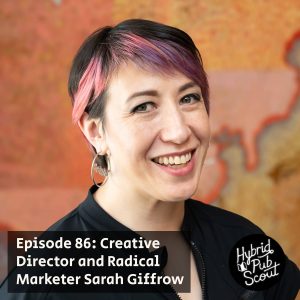
In this episode, I talked with Sarah Giffrow, an expert in helping small businesses with their online presences. If you weren’t aware, I worked for Sarah’s business, Upswept Creative, for a couple of years and witnessed the similar workflows and software used for publishing, website design, and digital marketing.
It’s not a galaxy-brained take to say that the tools that make up those workflows seem increasingly hostile to users—and I’d venture to say both the environment and the economy as well. Completely divesting from every problematic platform isn’t realistic for most people’s work, but as far as I’m concerned, that’s no reason to give up.
Both Sarah and I do our best in this conversation to find a balance between “you have no choice but to succumb to your billionaire overlords” or “smash your phone with a sledgehammer and run into the woods.”
Hopefully, it empowers you to try to nudge your ethics and your tech use into closer alignment.
Sarah Giffrow
Sarah’s path was set in the days of the Old Internet, after she built her very first webpage in the ’90s. She was raised in a tech-savvy household and went on to get a B.S. in Multimedia Design from the University of Oregon.
Sarah is the Creative Director + Benevolent Overlord of Upswept Creative, which was born out of her previous side-hustle as a photographer, where she often found herself seized by the irrepressible urge to help her photography clients improve their websites. These days, she calls herself “a website nerd and accidental marketer,” and learning about online marketing over the past decade has only made her better at websites and promoting small businesses in the big world of the internet.
In her newsletter, The Radical Marketer, Sarah writes about how to cope with online marketing when you’re trying to survive in a capitalist world. She digs into online marketing trends, and what small business owners do (or don’t) need to worry about. She guides readers towards building online marketing habits that feed their missions, without filling the pockets of tech billionaires, and helps business owners to bring more of the radical acts and ethical practices that matter to them into their online marketing.
Links of Note
- The Radical Marketer
- Article about getting the plastic out of the Pacific Garbage Patch
- Bot Farms and the Troll Toll – American Hysteria episode
- Better Offline podcast
- Lex Roman
Tools:
Interview Transcript
Emily Einolander 00:00
Hi Sarah. Thanks for coming on. Thanks for having me. Yeah, I used to work with Sarah back in Wow. 2019, 2020,
Sarah Giffrow 00:14
it doesn’t sound so long ago, and yet it feels so long ago.
Emily Einolander 00:17
I finally, like reached the point where it does sound long ago, which maybe is good, but maybe is really bad.
00:24
Yeah, it’s, it’s, it’s starting to but, but yeah, time is a weird social construct. Cool.
Emily Einolander 00:32
So Sarah, can you tell us a little bit about yourself and about your business? Yeah?
Sarah Giffrow 00:37
Um, so I Yeah. My name is Sarah giffrow, and I’m the creative director and benevolent overlord of upswept creative and we build WordPress websites and the online marketing for service based entrepreneurs and nonprofits. So So yeah, we’re basically thinking about your website, your social media and your email marketing, for folks who just need to spend less of their time on their marketing and have it actually do effective things for for what they’re trying to achieve.
Emily Einolander 01:11
Because marketing takes forever. I just, you know, I see all these people who are like, this is how you make 20 posts in an hour, like, you know, five minutes, which, I mean, come on, that’s nonsense. But, like, I spend so long writing a post that I’m just like, Who are these people and how do they do this? So, I mean, it’s good to have experts maybe, you know,
Sarah Giffrow 01:33
yeah, I mean, I mean, note that nobody, nobody who’s saying that, says that they’re necessarily good posts. Now this is, actually, this is something I thought about because, yeah, I’ve been because, yeah, I’ve also, a few months ago, started a newsletter called The radical marketer. And I have found that to be, I I found that to be, you know, decently easy, at least on the scale of things, to create content for. It’s it’s a it’s topics that I have lots of things to say about. But like, yeah, these past couple weeks, I’ve been like, oh, reflecting on the end of the year, and I’m writing about different things. And, yeah, there are just certain buckets of content that take me so much longer and are just like, it’s so much harder to just like, squeeze the lemon hard enough to get the little drop of wisdom that’s in there.
Emily Einolander 02:34
I’ve been loving the radical marketer that’s kind of one of the major basis for this entire interview is just some of the stuff you’ve been saying is, to me, a bit radical. You’re not just regurgitating the same well. I mean, you’re addressing the talking points that a lot of people are right now, but you’re not saying the same thing as what I’m mostly seeing, and it seems very realistic, but optimistic, which I’ve been enjoying about tech and about people’s use of social media and the way our brains work, which is really nice, especially for like, neurodivergent people. It’s, it’s like, Oh, I’m not, I’m not a weirdo by myself who can’t handle the world.
Sarah Giffrow 03:21
Yeah, yeah. And it’s, it really, I mean, I think, you know, at the core, I’m just, I’m always, I’m always going to have that little bit of optimism, like, even if it’s just completely blind optimism, it’s going to be in there, but, but, yeah, I think we’re just, we’re at a point where everything feels very like super intense extreme, like, you know, we’re like late stage capitalism. We’re seeing like, all of the, all of the best and worst things that could possibly happen. I mean, a lot of them on the worst ends, but, but, yeah, it’s, it’s sort of the internet is just sort of like that too, where, like, you’ll see, like, the most wonderful, heartwarming thing you’ve seen, like, in months, and then like, something that makes you want to, like, throw your computer out the window and run away to Alaska in the span of 10 minutes. Exactly.
Emily Einolander 04:15
I did see an article last night, and I don’t remember the date on it. Maybe this was a while ago, and I just missed it, but there was an entire thing about a guy who invented something that he’s been able to get, like, a million pounds of trash out of the Pacific Garbage Patch, right?
Sarah Giffrow 04:34
Yeah, yeah. And we would never just hear about that, unless maybe we happened to know the guy. But now we have the internet,
Emily Einolander 04:43
and it’s literally, literally a page where it’s like, here are some good things, like, I need to follow this.
Sarah Giffrow 04:50
Oh yeah, yeah. That is a response to a very, very needed thing. Yeah.
Emily Einolander 04:58
So I. So this is a publishing podcast. This is for authors. This is for publishers. And so one I find that a lot of things that you do overlap with things that I do, and one of those things is a lot of the tools and processes that we need to grapple with. You know, whether we’re using it, whether we’re not using it, which of them we are using? So what? What types of digital services do you need to do your work?
Sarah Giffrow 05:30
There’s definitely a lot of overlap in those tools. Like, a lot of a lot of what I do in a day centers around words like, I, I’m very much about, like, all right, please, let’s have your copy dialed in before we really start designing this thing. Because so much of design and marketing is, is, you know, it hangs on, you know, the quality of the words that are involved. So, so, yeah, there’s, there’s going to be, you know, word processing, collaborative document editing. And that’s, that’s probably the biggest thing. And then there are visual design tools, certainly, and, and, yeah, also, yeah, CRMs, oh, yeah, yeah,
Emily Einolander 06:19
yeah, that’s, that’s probably one that you do a lot more than I do at this point. But I, I guess a lot of publishing business owners probably have to deal with that.
Sarah Giffrow 06:28
Yeah, I feel like those are the big ones. And then, yeah, yeah, social media scheduling tools in particular, yeah, that’s probably Yeah, and, and email marketing tools. I mean, they’re just, there’s so many tools,
Emily Einolander 06:44
and more and more of them just seem to be minefields of ethical problems these days.
Sarah Giffrow 06:51
Yeah, that’s, that’s the, that’s the fun thing we get to navigate. So there’s
Emily Einolander 06:58
the AI encroachment on every single tech platform ever, and, and you’ve, you haven’t taken that lying down. I have noticed from what you’ve been writing about, so how’s that been? What’s been your response over time, and how’s that changed? And how do you keep your energy up?
Sarah Giffrow 07:16
Yeah, it feels like just a bit of vigilance. Because, I mean, it seems like you’re constantly having to say, like, no, please don’t write this email for me. No, please. I don’t want to try your new AI tool, but, but, yeah, I think, I think I may have been more open to it in the earlier stages, but I think my opinion has stayed pretty much the same over time in that it seems that the AI boosters are really well able. They’re really like trying to push hard into the creative spaces and and I have a, I mean, I have a huge problem with that, as you know someone who does design and marketing, because, because, yeah, I mean, what people ultimately want to achieve, particularly with marketing, is, you know, they want to stand out, and they want to be memorable. And so many of these llms are just, they’re pulling from things that already exist, and the result is predictably, just very samey, samey. And, and I really, and, yeah, it’s, it doesn’t have the capability of, like, you know, creating new ideas that that will stick in people’s minds. So, yeah, I’m very, I’ve been pretty vocally against that use of it, because, yeah, I think we need more humanity in the online spaces. You know, I saw some like, horrifying statistic about, like, some online platforms being, like, 50% bots.
Emily Einolander 08:54
Yeah, you were talking, you were talking in one of your newsletters about dead internet theory. And I was like, do you, do you, like, believe that’s true, or
Sarah Giffrow 09:05
I don’t think I’m there yet, but, like, yeah, it’s, but yeah, it’s sort of, it was just sort of an alarming, an alarming realization that, like, you know, yeah, there are people Like, using bots to achieve certain often nefarious ends, and, and, yeah, and we can’t, you know, it’s, it’s kind of messed up, that this, that this tool that was supposed to connect us all in this, in this beautiful manner, like, is now a space where we can’t even be certain that we’re dealing with an actual person there.
Emily Einolander 09:36
Yeah, and you have been on the internet back when it was fun. I mean, I was, I was for a while too, but I think you were, like, more participatory and, like, earlier stages of it. But, yeah, I just remember having a good time. It was dangerous. Sometimes like to to be online, you had to be a little bit more, like, keep a good eye out. But I think you should now too. And people have sort of lost i. Sight of protecting themselves online, but I don’t know, it almost feels like giving up to a certain extent, because there’s just so much push to be a certain way and be in certain places. And it gets exhausting after a while, because you’re just trying to do your work and you’re trying to see what’s going on with people, and, you know, trying to find a concert to go to or whatever, and it’s just this endless barrage of nonsense. Yeah, yeah. Now I’m ranting. I am gonna, I am going to link that American hysteria podcast that you put in one of your newsletters about, like, the the troll bots. Yeah, that’s, that’s really interesting. I think I’m gonna link it in the show notes. I think everyone should listen to it. But yeah, oh, I did want to ask you. Said, back when Gemini was really, like, getting involved and, like, was, ever was, you know, I, I don’t even know if it’s working or not on my computer anymore. I’m just like, I tell it No, but I still see it and you said that you were you said that you were on the phone with them trying to get it off of the upswept drive. Did that work?
Sarah Giffrow 11:20
Yeah, I think. So I, I went hunting for the proper toggles in the in the Google Admin to, like, turn it off. And so theoretically, it seems like that should have done it, but then it didn’t. And so I think, um, I think I came up just short of calling someone where, like, I had, they had this really circuitous like, you know, here’s how to contact support and and it just seemed like an endless loop. But I did actually, I ended up having to chat with an actual person who had to, yeah, toggle some mysterious things on their ends to, like, actually turn it off. So now it’s not there anymore. And I love that, but I the better part of an hour.
Emily Einolander 12:05
I’m very impressed I did not go to those lengths. But then there’s just one of me. So in your newsletter, the radical marketer, you’ve talked a lot of about divesting from different platforms, and I’d love to hear more about what that process has been like, how you made the decisions. I especially want to hear about how you, as a designer, ditched Adobe, and we have to talk about meta, obviously, because that’s that’s been a big one for getting rid of this year.
Sarah Giffrow 12:35
Yeah, yeah, yeah. As far as pulling pulling away from Adobe. That’s actually turned out to be similar or simpler than I expected. Yeah, I essentially, I had the entire Creative Suite. And I think that, you know, as, like, the focus of my business has narrowed, like, the activities that I’ve been doing also, you know, narrowed down a little bit, I essentially had to do some research as to, like, what else is even out there in terms of design tools. I I had some experience with Canva, which has had its uses. I use it with my team, sometimes just for, like, collaborative editing, so that I can design most of a thing, and then my social media manager can just plug in the necessary words. But it’s definitely, it’s definitely not as robust of a tool. But I ran across a an alternative called the affinity so they have a publisher photo, and and designer apps, and it’s, it was kind of a throwback, because it was, it was back. It was like, buying, you know, the Adobe Suite back in the day, or just like, Oh yeah, you pay a few $100 once, and it’s yours forever. Incredible. I missed that.
Emily Einolander 14:01
I was looking at them yesterday, and it did look like it was a affiliated with Canva. That is that correct?
14:09
That sure about
Emily Einolander 14:11
could be. But, I mean, yeah, the issue with Canva for me was just I was using Adobe for so long, and I’m used to like Photoshop and and in design that I was just like, where, how do I make a rectangle? Oh, regular ass rectangle, please.
Sarah Giffrow 14:32
That was, yeah, that was definitely, like the that was definitely the most challenging part of the transition. I definitely took advantage of the free trials so that I could, like, get my bearings and, like, actually make sure that I could actually perform the tasks that I wanted to perform in affinity. And, yeah, a lot of it was just this being like, Oh, they use a different word for this function than what I’m used to in Adobe. Are like, Oh, it’s open this menu instead of this menu. So just figuring out where things live, like and, and honestly, you can, you can Google it, find the answer pretty quickly. Yeah, the the first, the first design piece that I did in Affinity Designer, I, like, I was very diligent about setting my timer and like this took about the same amount of time, and I had not really had a ton of experience with this app, so I felt like that was encouraging. And at that point I was like, Well, I think, I think it’s, I think I feel safe clicking the Cancel button on my Adobe subscription.
Emily Einolander 15:39
I think I found the one. So, yeah, so you, I’m glad to hear that wasn’t too difficult. It does seem like such a monolith that, you know, it’s intimidating to try to get off some of these platforms, but you’ve talked a lot about leaving meta as well. What’s that? What’s that been like for you? But also, like, what’s that been like for some of your clients, if, if they’ve tried, or have they tried?
Sarah Giffrow 16:08
Yeah, I think that, yeah, that’s been kind of interesting and and definitely a more layered issue. We actually, we actually left our basically, have, like, abandoned our Facebook page. Like, you know, we’ve put up a bunch of notices saying, like, here you can find us on these other platforms, but we’re not maintaining an active presence there anymore. And, and for us, that seemed like the right call. It never really been one of our top performers. And, and, yeah, any anymore, as like more and more users are peeling off of the platform, it just seemed like our audience wasn’t there anyway. So it’s it felt like it was, it was time to to pull out of that. We’re still on Instagram and and that seems to be doing okay, but I talk a lot about, about disengaging from ads, as much as you can because, because, yeah, that’s that’s basically feeding the base
Emily Einolander 17:08
disengaging, like, as a user or as a poster, or, yes, yes,
Sarah Giffrow 17:16
yeah, definitely. I think it’s been a lot harder to like, unlearn the instinct to like, click on a thing if it shows me an ad. I like, yeah, yeah. So it’s been like, Okay, I’m gonna go over here and Google it instead of like, instead of clicking through on this and and putting, you know, 20 more cents in their pocket, which, you know, at scale, that ends up being a lot. But yeah, as far as client work goes, I think they’ve there. Haven’t, they haven’t made a lot of changes and and interestingly, one of, yeah, I’m thinking of a client in particular that we have, that that is a nonprofit, and there’s been a lot of like, there’s been a fair bit of, like, churn in terms of their following, yeah, where it’s like, oh, you gained like 221 followers this month, and you lost like 72 but, but, I mean, it’s still a net gain. So you know, in that, in that respect, they’re still performing really well and, and, you know, those 72 people were probably bots, or they were probably, or maybe they decided they didn’t want to be on Facebook anymore. Like, this is it just, there’s a lot of like, volatility in the numbers, and so you really kind of have to look at them and see, like, okay, but, but like, Yeah, where are the net gains? Like, where are we actually seeing results? And they are still seeing results. So, so, yeah, it’s, it’s felt like the right move for them to stay the course. But yeah, I, I also, yeah, I think that’s been the big thing about a lot of my discussion around meta is that, you know, I want people to be aware that there are, there are other options. There are other channels. I could yell about email marketing all day because they’re just not enough people doing it. But, yeah, but I also want to be sensitive to the fact that, you know, there are certain tactics that you know maybe have historically worked, and just pulling out of those completely is maybe not an option right now. So, so it’s really, I try to be case by case about it. And you know, we can always, you know, have that aspirational goal in our minds and and make those incremental changes over time. But yeah, it’s, it doesn’t have to be a cold jerky thing. And, yeah, I also encourage people to, you know, not just delete everything because they’re really mad one day, but to, you know, plan the departure.
Emily Einolander 19:51
Yeah, that’s, that’s definitely a risk, because just so many things happen to make you mad.
Sarah Giffrow 19:58
Yeah, yeah. Yeah, I’ve thought about it often, but I’m still out here. The cat videos are keeping me in
Emily Einolander 20:09
I did divest from meta in my personal life and in hybrid pub Scout, I did have to get back on Instagram with my like author pen name, because I didn’t really know what else to do, and that’s something I’ve been thinking a lot about with authors. And because there is email marketing is really, really effective. But there’s also that chicken and the egg thing with your email list, because it’s like, how do you actually get people to join the email list? And there’s, you know, stuff at the back of your book where you can direct people there, but then it’s like, how do they find the book? And then it’s like, Amazon ads. And I’m like, is that really better than being on Facebook? So it’s just this really like net. It’s just a net. It’s a bunch of tangled things that go together and you it feels sometimes like you have to have the right combination, or you’re just kind of dead in the water.
Sarah Giffrow 20:59
Yeah, and, and that’s something I’ve been talking about too, is, is, you know, making use of the free capabilities that are available. So, yeah, if we’re not, yeah, if we’re not buying ads from metal all the time, like they’ve still made this tool freely available to us. People are using it for all kinds of things, promote their businesses, to do activism, like, if it’s out there, if we know we can reach people through it, then, then I there’s, there’s certainly an argument for taking advantage.
Emily Einolander 21:32
Yeah, that’s fair. So one thing I thought was really interesting, and that I feel like you’re one of the only people I’ve seen saying this, is, you know, authors, especially like I’ve been listening to podcasts where they’re being urged to optimize books and they’re publishing businesses, if it’s a business, rather than, like self publishing, to optimize for LLM search engines, especially chat, GPT. But you said that you’re not convinced that that’s going to be a long term thing, like you’re you seem skeptical that that’s going to be something that people are going to be locked into, unless you’ve changed your mind since the last time I saw you posting about it. But I love to hear more of your thoughts on that.
Sarah Giffrow 22:15
I my first thought was to go back to thinking about what search engines, how they used to work, and how they kind of do now, in that we’ve essentially, we’ve kind of broken organic search, because everyone is trying so hard to optimize for it. Because, you know, you think about like, you know, 10 years ago, if you would like Google something, you might actually get some relevant information. And if you Google the same thing, now, like so much of it is, is just like weird, click baity, hyper optimized articles from like directory sites or blogs that that you know don’t actually, that don’t actually answer the question you’re trying to answer, it’s just that they have all the right keywords in the right places, and so they’re showing up on page one and and, yeah, and that’s just that’s kind of where we’ve ended up, where we’re back to not being able to find what we need, because everyone is, like, working so hard to, like, get to page one of Google.
Emily Einolander 23:20
Yeah, no, I remember that was part of what I was part of my expertise. I put that in scare quotes, since this is an audio medium, yeah,
Sarah Giffrow 23:34
and so I do expect similar to happen with LLM search. Is that? Is that? Yeah, once we’re all trying to optimize for that as well, then we’re probably going to get to us another place where, like, the hyper optimized things that maybe don’t even have any value are going to float to the top. Yeah. But then I actually tested this out with a couple of different LLM searches and and did a and basically compared that with like what showed up in organic search. And so I was able to basically determine that you don’t really have to, you don’t really have to make a ton of drastic changes to optimize for LLM search, like the big finding that I came across, I just Googled things about website WordPress, website designers, something I knew about and but yeah, I think the main thing difference there was that it seemed like a lot of the llms were pulling From directory sites, and that’s and that sort of thing. So so I feel like outside of that, a lot of the same best practices that you are using to rank in organic search are also going to carry over to LLM search. So, so, yeah, it’s basically not worth paying. Panicking over, yeah.
Emily Einolander 25:01
I mean, I a lot of what I’m hearing is like, put alt text on your photos and images and write posts about each of your offerings. And I’m like, That’s why haven’t you done that yet?
Sarah Giffrow 25:17
Yeah, these are all the things that we should be doing anyway, to be optimized for organic search. So not, not really, very much has changed ultimately.
Emily Einolander 25:28
So it’s less that you don’t think it’s going to be a thing down the road, but you just don’t think it’s going to be that different.
Sarah Giffrow 25:34
Yeah. I mean, a little, a little of both, but yeah, definitely I don’t think it’s going to be that different, at least, at least from what I could see at this point in time.
Emily Einolander 25:42
Are you insinuating about the AI bubble right now?
Sarah Giffrow 25:45
I mean, I’m just just trying to be open to possibility.
Emily Einolander 25:52
I’m just one person floating in an online world. I’m like, All right, I’m doing my best.
26:03
We’re all just doing our best.
Emily Einolander 26:05
I was deals with EDS and trans podcast.
Sarah Giffrow 26:09
Oh yeah, in measured doses. I get really mad if I get a
Emily Einolander 26:14
little stressed out. Sometimes I feel very like in that bubble, all by myself, sometimes alone in my house, working from home, and I’m just like, ah, Sam Altman
26:29
can’t raise his child without chat. GPT, so Yeah,
Emily Einolander 26:33
can you speak to that? Oh,
Sarah Giffrow 26:35
man, that was maybe the most dystopian thing I’ve heard in a really long time.
Emily Einolander 26:41
I honestly though, to me, I was just like, that sounds like a you problem, but, yep, yep. What happens when you don’t have any friends?
Sarah Giffrow 26:50
Yeah, you know, I don’t, I don’t claim to be good at people, but, but yeah, I’ve been able to. I made it through four years of parenting, and I have a pretty happy child.
Emily Einolander 27:01
All right? So I was kind of talking earlier about the whole the way that we’re all trying to create a web that makes sense for ourselves with the services we use, and the attempting to create funnels or pathways for customers to find us, or readers to find us, if we’re authors. And you know some of that has to do with just what’s available for free, what we’re willing to pay for, what we are comfortable with using like. And I know that I’ve been trying to reevaluate a lot of that stuff for myself lately, and it’s so just intimidating, and it feels like such a big undertaking to try to, like, be an ethical business owner or, you know, publisher of one or whatever in the world right now and so, like, when, if someone were to take a first step into that world of untangling their own tech use, like, what would you suggest?
Sarah Giffrow 28:04
I mean, I think that there’s something to be said for just looking at things that you’re doing in a day, and how much they how much time they’re taking up. Because, because one, I’ve done that on multiple occasions over the course of my career, and I feel like I’ve been surprised every time. Yeah, yeah. Then you also, you also get a sense of, like, what, which of those things is actually, you know, getting you closer to your goals, and which of those things aren’t. So, yeah, so, yeah, looking at time and looking at data, if you’re on, like, social media at all, you you know there are, there are statistics available. You can tell how many people are clicking on things, and, like, you know how many inquiries are coming through your inbox. And you know you can, you can, at least, like, get a general sense of of what’s actually moving the needle.
Emily Einolander 29:01
So kind of making that, like, cost benefit for like, how long you’re spending somewhere, versus, like, how much of a return you’re getting, or even, you know, and not necessarily, like, there’s, you know, there’s the customer return, there’s the ROI, but then there’s also just, like, maybe how it makes you feel,
Sarah Giffrow 29:19
yeah, yeah, very much. So, yeah, I actually so one of the one of the offerings that I have is it’s more of a coaching package for your online marketing. Like, one of the first things that I that I ask in the discovery phase is just, like, what kinds of content do you like making? Because like it like, for example, you know, I I love writing. I love writing my newsletter. I love the written format for anything. I will take it over speaking any day. If you ask me to make, like, a 15 second video, I will just be like, I can’t do it. I need. Had like, three weeks to hype myself up before I do this, and then maybe I still won’t. Like, yeah,
Emily Einolander 30:07
oh god. I heard this woman who was like, oh yeah. I decided to use Tiktok because I make like, three videos a day. No problem. Like, what are you videoing? Like, what is this video you’re talking about?
Sarah Giffrow 30:19
I’m exhausted just thinking about, I know I had to sit down.
Emily Einolander 30:23
I had to take I had to take a breather.
Sarah Giffrow 30:28
Yeah, you know it’s, it’s good to plug into. You know those those places where you feel strong, and those places where it’s just, it’s just really difficult to even get started, because, because, yeah, it’s, you know, if you’re having to force it like, I mean, speaking as an AD, AD, ADHD, human, the executive dysfunction will rear its head at every opportunity,
Emily Einolander 30:55
and then at one point you just kind of run out of energy. Yeah. Where does that leave you? It leaves you shutting down your social media accounts impulsively. Hey, guys, I’m back. Just kidding. So you were talking about affinity for design earlier. Can you also share some of your favorite, lesser known alternatives for like, app, software, digital services, newsletters, maybe for everyone on substack, the Nazi website?
Sarah Giffrow 31:34
Yeah, I have to, I have to shout out Lex Roman, because I was, I was in a community of hers, and saw her talking a lot about outpost. So that is where I run my newsletter through has a lot of those sub stacky In capabilities, yeah. And I think, I think a lot of, I think a lot of people, more people have heard of beehive at this point, then, then have heard of I’ve heard of ghost, but I’ve heard of ghost. Ghost? Yeah, I said outpost. I meant ghost, okay, yeah. Outpost is a tool suite that’s that works with, that works in tandem with ghosts God, and it’s yeah and, and it’s super useful for, like, all of those, like, welcome flows and and re engagement campaigns and and little things that you that you like to have when you’re trying to maintain a paid subscriber ship.
Emily Einolander 32:40
Yes, that’s a good one. And then you’re still using Google Drive for most of your assets management and stuff like that. Or, yeah, yeah.
Sarah Giffrow 32:54
I mean, I think I am just because, yeah, a, it’s there, and B, I turned off Gemini, and C, I use Google for email accounts. Oh, yeah, it’s just sometimes simplicity is, is a valid motivator.
Emily Einolander 33:11
Yeah, no, that’s fair. I agree,
Sarah Giffrow 33:14
yeah, yeah. But I think, yeah, I think something that, something that I’m actually looking to do in upcoming installments of the newsletters, is looking at, is looking more deeply into, like, Who’s behind various pieces of software or various apps. Because I remember, like, I remember back in 2020 when we are like, in the height of the Black Lives Matter movement, and, and, and I was thinking a lot about, like, okay, what can I do to really like, to really like, step into like, that, that, you know, diversity and equity and justice role as A business owner and like, actually, you know, take the anti racism a step further. And so I, like, started looking at, like, Oh, what are all these services that I’m using? Like, who’s actually running the show here? And like, I was pleasantly surprised to find that, for example, Calendly was a black owned tech company. I don’t know that cool, yeah. So, so that’s, that’s one to put in your back pocket.
Emily Einolander 34:23
I got it in my front pocket.
Sarah Giffrow 34:29
But, but yeah, I think, yeah. I think it’s worth educating yourself at least a little bit about, about, about the, like, the pieces of software that you’re using, and, India, and who and who’s behind the scenes, who’s behind the curtain, and what are they all up to? Because as ultimately, the most potent way we’re going to make our feelings known and make any changes is to control where our dollars go.
Emily Einolander 34:59
I’m looking for. Forward to that series that you’re going to do, because I would love to learn more about the people behind these apps, and it will help me a lot with decision making.
Sarah Giffrow 35:11
Yeah, that’s the goal. I think, yeah. It’ll probably lead me to make a few changes here and there, depending on what I learn.
Emily Einolander 35:20
Here’s a question. Is there anywhere on the internet where you’re still having a good time?
Sarah Giffrow 35:25
Whoa, yeah, yeah, yeah, I have to say when I think one of my biggest complaints since like, the mass exodus from Twitter rip Dad, is that I felt like I had so perfectly curated my my Twitter feeds, where it was like just this wonderful blend of like things you should know about, and also random things that are interesting and also really goofy internet jokes. And I haven’t really been able to recreate that since
Emily Einolander 36:10
there’s nothing like being on Twitter when something happened like that was, oh my God, it was the main character today, yeah. But, like, but the good ones, but like, the really fun ones that, you know, sometimes it’s just like a rage bait, but other times it’s just like, what is happening in this world right now. This is incredible, but i You can’t bottle that, and I think it’s a bygone era.
Sarah Giffrow 36:32
But, yeah, yeah. But I mean, I really, I really have to, you know, I really have to give it to, you know, anyone who is looking to engage online in a genuine way. I mean, I feel like, I feel like LinkedIn has been one of the more rewarding spaces for me over the past year, which, like, I would not have predicted myself saying that, but I’ve actually, you know, gotten, like, honest comments and feedback from people that I like to hear from. And it’s, you know, it feels, you know. I mean, it’s all very like, you know, within the bubble of like, you know, with under the umbrella of work stuff. But it is still like people are looking to have, like, genuine interactions there, which I appreciate, but, but, yeah, I just, I just have to say, you know, to all the people who, like, you know, want to ask you who you’re like, ask you to name your favorite Nicholas Cage movie, or who, like, can’t shut up about their dog. Like, just, just hold on to that, because I think the world needs it.
Emily Einolander 37:41
Like, oh, that’s a thing I like, I remember now. I think I need to do some more work curating my LinkedIn feed right now, because the stuff I get sometimes, like, basically, you’re one of the only people that I actually feel like interacting with right now. I saw a guy today literally say, Stop posting things that help people and giving away content for free. And I was like, he literally said, Stop posting things that help people. And I was like, what is happening? And I just was like, I am not engaging with this. That’s what he wants. That’s what he wants. He wants me to click on him, and I’m not gonna do it. But my goodness, that’s that attitude is kind of things in a nutshell right now?
Sarah Giffrow 38:29
People, yeah, oh, we have to, we have to fight that at every turn.
Emily Einolander 38:36
Yeah, it’s like, why should I put up everything I know behind a paywall? Like, that’s not how being a person works.
Sarah Giffrow 38:43
Yeah, yeah. Like, I love helping people. Why I do this job? Yeah.
Emily Einolander 38:49
For real, I was like, I don’t know if I’ll ever make money doing this podcast. Like, but that’s not why I’m doing Um, all right. Well, where can people find you? Online?
Sarah Giffrow 39:01
Yeah, so. So the newsletters at the radical marketer.com and and my services are at Upswing creative.com we are, we are on Instagram for the moment. We might be in jail because we like to talk shit about meta so much, but we’re on there, and we’re on LinkedIn, and we’re also on blue sky. So, oh yeah, those, those are the, those are the ponds we’re playing in right now.
Emily Einolander 39:32
Sounds good. Gotta play somewhere right now, or you don’t, but that gets lonely, I promise. Yeah.
Sarah Giffrow 39:38
I mean, you don’t have to. That’s, that’s always the thing I want to lead with. You don’t, technically, you don’t have to be in any
Emily Einolander 39:44
particular place, yeah, that is, that is true. You don’t have but there are consequences. All right. Sarah, thanks so much for talking to me today. This is really fun.
39:56
Thank you. I appreciate the invitation.